
How to Check Criminal History in Gibsland
First identify the record creator. No official Gibsland police search, blotter, report form, app, or records email was located. The verified municipal starting point is the town clerk at 318-843-6141. A citation can also be checked through the town-branded nCourt payment page, but that tool does not search names or supply a complete docket. Arrest bookings route to the Bienville Parish sheriff only after confirming the person entered parish custody.
- Read the citation or report agency line to determine whether Gibsland Police, the sheriff, or State Police created it.
- Call the town clerk for police-record and local docket routing, giving the event date and citation or incident number.
- Ask specifically whether the matter is in Gibsland Mayor's Court or the Second Judicial District Court.
- Call the sheriff at 318-263-2215 for a confirmed parish booking, jail docket, or custody route.
- Use the parish clerk or State Police Right to Review only when the question extends beyond the town record.
Gibsland Citation Portal Is Not a Search
The Gibsland nCourt page is a payment channel built around a citation number and amount. It does not advertise search by name, birth date, offense, or event date. No pleadings, docket history, disposition detail, or downloadable court file appeared in the public interface.
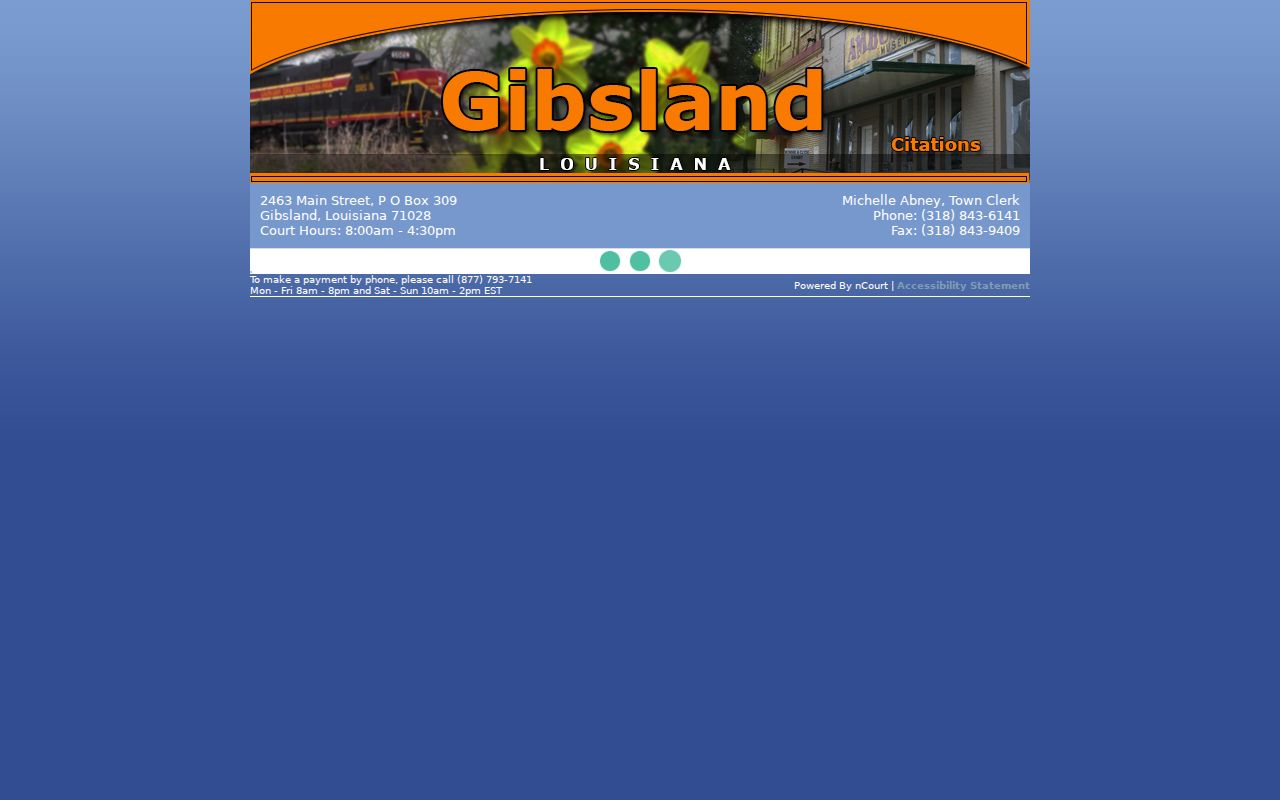
The screenshot reinforces the key distinction: a transaction result or receipt is not a Gibsland criminal case record. The portal's support menu includes reasons such as a ticket not being in the system and no record found, so a missing citation should prompt a clerk call rather than a claim that no matter exists.
Three contact paths serve different purposes. The web page accepts the transaction data. The payment vendor answers at 877-793-7141 on weekdays from 8 a.m. to 8 p.m. and weekends from 10 a.m. to 2 p.m. Eastern. The Gibsland clerk remains the source for the underlying town record and for questions about where the matter is heard. Calling the vendor cannot substitute for asking the custodian for a docket or certified disposition.
| Public control | Use | Known limit |
|---|---|---|
| Citation Number | Enter the number printed on the citation | No wildcard or name lookup shown |
| Amount | Payment amount | Validation rules not published |
| Continue/payment | Moves into the transaction | Not a docket viewer |
| Phone payment | 877-793-7141 | Vendor payment help, not town records custody |
The Gibsland Police Department
Gibsland police incident and arrest reports remain town records when that department handled the event. Research did not verify a dedicated records unit, direct police number, address, hours, report fee, request form, submission method, or retention rule on an accessible official page. Those gaps must not be filled with details from another town.
Use the verified town clerk contact as the routing point. Ask for the public-records custodian and name the exact item: initial incident report, citation, video, or mayor's-court docket. Provide the event date, time, location, incident or citation number, and involved agency. Request certification separately if needed, because neither availability nor price is posted. For a sheriff investigation that happened near Gibsland, send the request to the sheriff rather than the town.
This custodian check matters when several agencies work near town. A location described as “near Gibsland” does not establish that Gibsland Police created the file. Read the agency name on the citation or report, or ask the clerk to identify it. State Police citations follow the traffic court named by the state citation channel. Sheriff investigations, warrants, and jail entries remain parish records even when the encounter began on a road associated with Gibsland.
Call Gibsland When a Ticket Is Missing
The town-branded portal lists Gibsland at 2463 Main Street, P.O. Box 309, Gibsland, LA 71028. The town clerk line is 318-843-6141, fax 318-843-9409, with published court hours of 8:00 a.m.-4:30 p.m. A vendor phone line operates separately for payment assistance.
Before paying, ask whether the citation requires a court appearance and whether it belongs in the local tribunal. The inspected page did not publish a convenience fee, accepted-card list, refund rule, mandatory-appearance exclusions, warrant instructions, copy fee, or certification charge. It would be unsafe to infer any of those terms. Have the citation number ready, explain that the ticket is absent or unclear, and ask the town clerk for its status and the correct next step.
Arrests and Bookings in Gibsland
No official source identified a Gibsland city jail or a municipal booking roster. The Bienville Parish sheriff is the parish jailer, but the exact municipal transfer arrangement was not published. Confirm that an arrestee entered parish custody before treating a sheriff jail entry as the next record.
The record chain can split quickly. Gibsland Police may keep the incident or arrest report. The sheriff creates the parish jail docket and booking information if a transfer occurs. A prosecutor and the Second Judicial District clerk create separate documents if charges are filed. Booked charges may later be reduced, replaced, or dismissed. The Bienville Parish arrest history route covers sheriff, jail, and state custody channels in more depth.
Gibsland Citation Versus Parish Booking
A town citation and a parish booking do not prove the same event or status. The citation records an alleged town or traffic violation and directs the recipient toward a court channel. A booking records physical custody and intake at the jail. Either can exist without the other.
Ask four distinct questions: Which agency wrote the report? Was the person booked by the sheriff? Did a prosecutor file a charge? Which tribunal entered the outcome? This prevents a payment receipt from being mistaken for the court file and a jail charge from being reported as a conviction. It also explains why a case may be visible at the parish clerk even though the first encounter occurred inside Gibsland.
Gibsland Municipal Court Records
No special statutory Gibsland city court was identified. Louisiana law generally supplies a mayor's court for a municipality outside a separate city-court structure. That tribunal hears municipal ordinance violations. The nCourt page confirms a local citation and court function but does not identify a judge or show a docket. Ask the clerk whether the requested record is a Gibsland Mayor's Court matter or a Second Judicial District case.
| Court Name | Ask whether the formal record is Gibsland Mayor's Court or Second Judicial District Court. |
|---|---|
| Case Types Heard | Mayor's-court authority covers municipal ordinance violations; state-law matters route elsewhere as required. |
| Case Lookup Channel | Town clerk by phone or counter; no public name-search docket found. |
| What the Docket Shows | Ask for citation, setting, disposition, balance, appearance status, and warrant or attachment status. |
| Copies & Fees | No official copy or certification schedule was located; request a quote. |
Request the Gibsland Mayor's-Court Docket
Louisiana R.S. 33:443 requires a mayor's-court docket. Even without an online case screen, the responsible municipal office should therefore hold a docket. Use the precise phrase “mayor's-court docket” when calling. Also give the citation number, defendant name needed to locate the public record, approximate date, and desired item. Ask whether the result is merely a balance or includes the charge, setting, plea, disposition, and certified-copy option.
An appeal involving imprisonment or forfeiture of rights or property can move to district court for a new trial under R.S. 13:1896. That can produce both a municipal record and a Bienville Parish district-court record. A local cost may also include the $7.50 assessment authorized by R.S. 15:1097.6 for qualifying convictions, pleas, or bond forfeitures. It supports the Ware Youth Center Authority and may explain why a total exceeds the base fine.
Where Gibsland Records End Up
Recent activity stays closest to its creator. Town police holds its incident file. The sheriff holds a parish booking. The clerk holds the filed prosecution and disposition. Louisiana State Police BCII may later receive a fingerprint-linked arrest and court outcome for LACCH.
Record flow: Gibsland Police › Bienville Parish Sheriff › Second Judicial District Court › Louisiana State Police BCII-LCJIS
This is a route, not a promise that every stage exists. A citation may remain municipal. An arrest may never become a filed charge. A court dismissal may take time to appear in a repository entry. Search the newest event at the local custodian, then use the parish clerk for the adjudicated file. A personal Right to Review is the official way to inspect one's fingerprint-based Louisiana record.
Gibsland's Official FBI Record Trail
Gibsland has an unusual official historical-record channel. The FBI states that officers killed Bonnie Parker and Clyde Barrow in an ambush near Sailes in Bienville Parish on May 23, 1934. An FBI anniversary account describes the road as near Gibsland. Those descriptions are compatible: Sailes identifies the more specific area, while Gibsland is the nearby town used in broader accounts.
The FBI Vault Bonnie and Clyde collection publishes the Dallas field-office file in seven parts.
These archival files support genealogy and justice-history research. They are not a modern Gibsland name search. The federal Bureau became involved because interstate movement of a stolen automobile created federal jurisdiction, while state and local officers carried out the ambush. The archive illustrates how one investigation can leave records with several agencies.
Gibsland Crime Data Needs Coverage Checks
Gibsland had 773 residents in the 2020 Census, making it Bienville Parish's third-largest incorporated place. No official town annual police report or verified local offense table was located. The FBI Crime Data Explorer is the proper official source for agency-year data, but users must inspect participation and months reported.
A blank value does not necessarily mean zero crime. Offenses known to police, arrests, citations, calls for service, and parish jail bookings are different measures. Do not build a town crime rate from a news story or a partial reporting year. A responsible figure states the agency, year, number of reporting months, population basis, and whether the value counts offenses or arrests.
Public Access Rules
Louisiana Public Records Law applies to town and parish custodians, but a request must reach the office holding the exact record. The law is not a demand for every investigative document. It preserves access to specified front-end records while permitting exemptions for confidential sources, investigative methods, protected victim details, criminal intelligence, and other sensitive material.
Key Statutes:
Louisiana R.S. 44:31 gives a right to inspect or copy public records subject to exceptions.
Louisiana R.S. 33:441 authorizes mayor's-court jurisdiction over municipal ordinance violations.
Louisiana R.S. 33:443 requires the mayor's-court docket and provides for a marshal.
Frame the request narrowly. Ask for an initial report, citation, docket entry, disposition, or certified copy and provide a date, location, agency, and record number. An accusation is not proof of guilt. If the record has moved into parish prosecution, contact the district clerk instead of pressing the town for a file it does not hold.